Tag

Undressing Disability Archives | Enhance the UK

A close up of two gold wedding rings on a table

6 Top Tips to Make Your Wedding Accessible for Disabled and Neurodivergent Guests

By Sex & disability, The Love Lounge questions, Undressing Disability

There is a lot to plan when it comes to weddings, from cakes to catering to dresses and suits. Adding accessibility doesn’t have to be difficult, but it does have to include more than just ramps. 

Here are some top tips on how to make your big day accessible to everyone.

1. Start with Accessibility in Mind

When you are scouting venues, think about what access your guests may need and ask questions in advance. This could include things like:

  • Are there ramps, lifts and accessible bathrooms? That’s not just for outside the venue but inside too, so if somewhere has internal steps, ask if they offer alternative step-free access.
  • Are there accessible parking spaces near the entrance? Are there drop-off spaces nearby?
  • Working on seating arrangements doesn’t just mean not putting that auntie near that cousin, but also ensuring there is enough space for wheelchair users to sit comfortably, move, and see the ceremony or dinner table.

2. Communicate Early and Clearly

It’s a good idea to include a section on access requirements on your invites or wedding website. Be mindful to mention dietary requirements too, as that will shape the food you select. It’s not just about asking but also implementing the information you receive, too.  

If you are sending more information either with an invite or through a wedding website, then think about a section that gives information on step-free routes, quiet spaces, dietary information and timing for the day. All of this is very helpful for disabled and neurodivergent guests.

3. Create a Sensory-Friendly Environment

For neurodivergent guests, weddings can be overwhelming. Consider adding:

  • Quiet zones: Offer a calm room or outdoor space where guests can retreat from the noise and lights.
  • Lighting and sound: Avoid flashing lights or very loud music. Opt for adjustable lighting and let guests know in advance if there will be loud moments (like confetti cannons).

4. Catering and Dietary Needs

Dietary accommodations are a key part of accessibility. Ensure your caterer can handle:

  • Allergies (gluten-free, nut-free, etc.)
  • Religious or ethical diets (halal, kosher, vegan)
  • Conditions such as coeliac disease, which means not just gluten but also oats. Food needs to be coeliac safe and prepared in an area that is sanitised to avoid cross-contamination.

5. Accessible Entertainment and Activities

Think about how guests will engage with your entertainment. This means you need to think about the flow of the room so that there is enough space for wheelchair users to navigate the space, and use entertainment such as photobooths. 

Be mindful of choosing activities that are loud (balloon popping, for example) that neurodivergent people may struggle with or those that require standing for long periods of time. Make sure that you have seating available for anyone who needs it – especially after the dinner section of the evening is cleared away. 

Dancefloors will need to have some seating at the edges for people to rest. 

6. Ask, Dont Assume

Every disabled person has different requirements – even those who have the exact same condition. If you know that you have a guest who may have requirements, it’s best to ask them what they may need rather than waiting for them to come to you. After all, sometimes people forget to reply to invites or emails!

It shows that you are being proactive and value their attendance at your wedding. It’s easier to incorporate accessibility from the start rather than trying to rectify any issues that arise later on. 

Want to read more blogs on disability? Why not visit our blog page to find more!
A person wearing light pink pants, bright pink socks with orange trim, and mauve sneakers with white laces is playfully kicking their legs up against a solid pink background.

Run Alton Towers for Enhance the UK!

By Event

We are inviting you to come and fundraise for Enhance the UK, a charity dedicated to breaking down barriers and changing perceptions of disability.

Join us on 15th November 2025 for Run Alton Towers – the UK’s most thrilling theme park race.

Free Park Entry, Medal & Goody Bag 🏅

Sign up by visiting our Enhance the UK Alton Towers page

Every runner receives a medal, a goody bag, and free entry to Alton Towers for the entire day. After your run, celebrate in style with roller coasters, attractions, and a well-earned treat!

Distances for Everyone 🏃‍♀️

Whether you walk, run or self-propel, there’s something to suit you: 5K, 10K, or Half Marathon. Plus, with a junior race, the whole family can join in the fun.

Simply pay £20.80 to secure your place and pledge to raise a minimum of £100 in support of Enhance the UK. We have 30 spaces available – first-come, first-served!

Run for inclusion, Run for change. Run for Enhance the UK.

Sign up today and be part of something unforgettable!

Sign up by visiting our Enhance the UK Alton Towers page

Pink and red paper heart in a chain

Love Lounge: Need advice on finding love after a stroke

By Sex & disability, The Love Lounge questions, Undressing Disability

The Question:

I had a stroke 5 years ago, in my 30s. I lost 80% of my left hemisphere and had to learn to walk and talk again.  I’m so lucky that I have regained my mobility and speech – I know others who have only lost a tiny part of their brain, but due to where the stroke was, have lost speech. 

My difficulty is that I can’t read or write. This makes daily life such a challenge – looking at timetables for buses, planning, meeting people, and I can no longer work.

My relationship broke down and I’d like to meet someone else but it’s so hard using dating apps when I can’t read and write. There’s no flow and everything takes ages to copy and paste for my phone to read it to me, so I think people will lose interest. Any ideas?

Jayden

The answer:

Hi,

Well done on your recovery for a start! 

Are you using the accessibility features on your smartphone? iPhone has a built-in screen reader called VoiceOver, and the Android equivalent is called TalkBack.  These will speak back to you what is on the screen and give auditory descriptions of screen elements, notifications and alerts. However, they definitely take a while to get used to navigating it. As your sight isn’t affected, a YouTube video tutorial might be beneficial!!

Another option is to use dating apps that allow you to send voice notes and videos – such as Hinge. This means you can be more free-flowing and show your personality as you are, rather than taking ages to send messages back and forth.

The other way is to go old school and meet people in person! Get involved in activities, etc, that you enjoy and meet people that way. They’ll have a common interest and see all elements of you, not the restricted version, battling with text messages! 

Best,

Zoe

Want to read more Love Lounge questions? Head to our blog post page to find more

A person is pulling the strings of a black PVC top closed over their breasts

Love Lounge on…….kink and sex toys

By Event, Sex & disability, Undressing Disability

We’re back and by popular demand, so is our discussion on all things kink! Join us for a discussion around navigating kink toys and the scene as disabled people.

Featuring the brilliant Jennie Williams, Jody Sill, and Katherine Sellors, this is your chance to ask questions, share experiences, and get real answers to all your red-hot questions! We will also be featuring toys from the kink specialists, Whippletickle.

Whether you are curious about kink or looking for a new favourite toy, don’t miss this open, inclusive chat and hangout

All proceeds from ticket sales (excl. Eventbrite fee will go to the charity, Enhance the UK, to help us keep Love Lounge sessions free.)

📅 Date & Time: September 25th at 7:00pm

🎟️ Buy your ticket here by visiting the event page

Jody Sill (she/her) is a COSRT-certified psychosexual therapist, specialising in kink and LGBTQ+ sexuality. She is also a published researcher in the field of sexuality, a kink educator, and an openly queer and kinky person who enjoys nothing more than empowering people to live their most pleasurable, confident, and authentic sexual lives.

Katherine Sellors (she/her) is an occupational therapist who qualified in 2020. She has been interested in supporting accessible sexual expression since university and has been working with Undressing Disability ever since.

Jennie Williams (She/Her) is the founder and CEO of Enhance the UK, a leading disability awareness charity. Passionate about breaking down barriers around disability, relationships, and sexuality, she created the Undressing Disability campaign to challenge stigma and promote inclusive conversations.

Please email cj@enhancetheuk.org for access requirements ahead of the event. The event will be held online.

Contact: Please note that we may contact you from time to time to let you know of services and resources that we think will be of interest to you. If you would like to opt out of receiving these emails, please email hello@enhancetheuk.org

Any questions or queries: CJ@enhancetheuk.org

This event is a fundraiser for Love Lounge to help us keep providing our services for free to disabled and neurodivergent people. All proceeds from ticket sales (excl. Eventbrite fee will go to the charity, Enhance the UK)

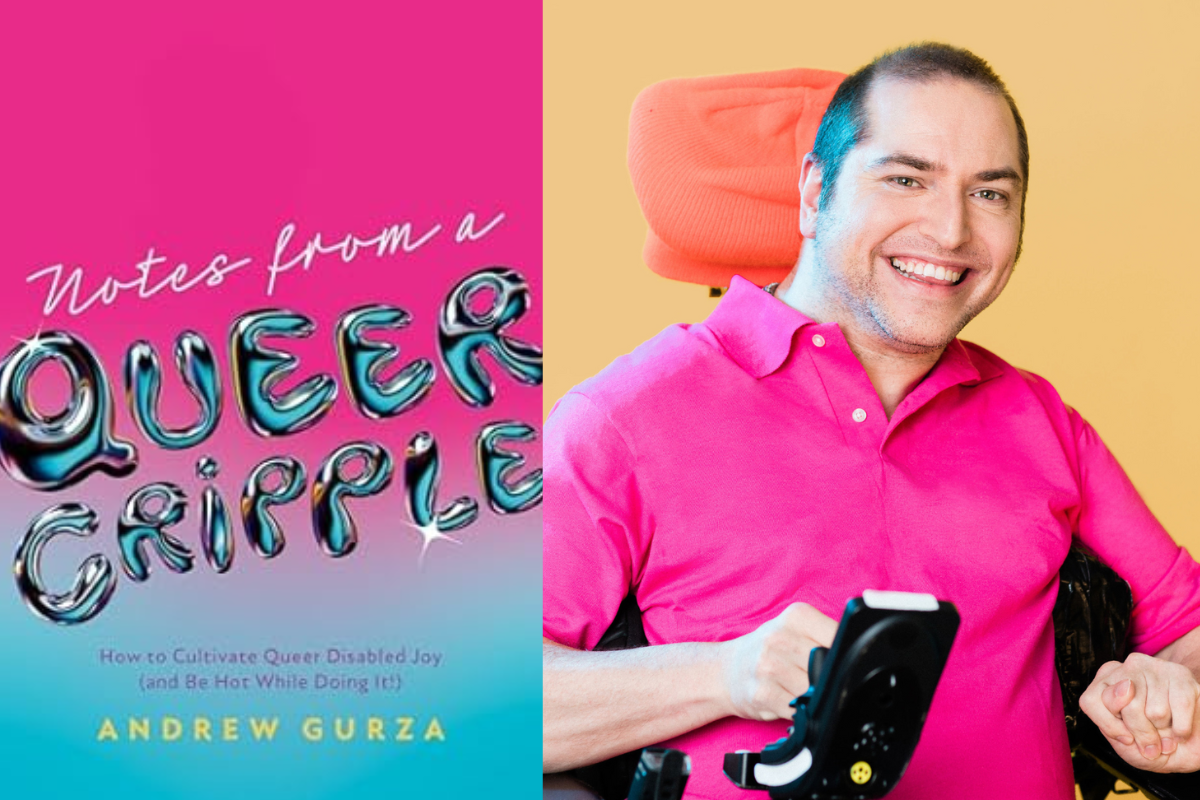
Split image. On the left is the book cover of “Notes from a Queer Cripple: How to Cultivate Queer Disabled Joy (and Be Hot While Doing It)” by Andrew Gurza. The title features shiny, metallic balloon-style text on a pink and blue gradient background. On the right is a smiling person wearing a bright pink shirt, seated in a power wheelchair with an orange headrest, against a soft yellow background. They are holding the wheelchair controls and looking directly at the camera.

Andrew Gurza….on his new book, online visibility and queer spaces

By Disability, Sex & disability, Undressing Disability

There is no better time to be following Andrew Gurza on Instagram than right now. His debut book, ‘Notes From A Queer Cripple: How to Cultivate Queer Disabled Joy (and Be Hot While Doing It!)‘ is due for release on April 26th through Jessica Kingsley Publishers and it is a joy to read. The book, much like Andrew’s Instagram is an unapologetic, open, honest account of queer disabled experiences and sexuality.

Andrew bounces from topics such as ableism to accessible spaces to the realities of coming out to carers. All this is in his trademark humour and relatable writing style.

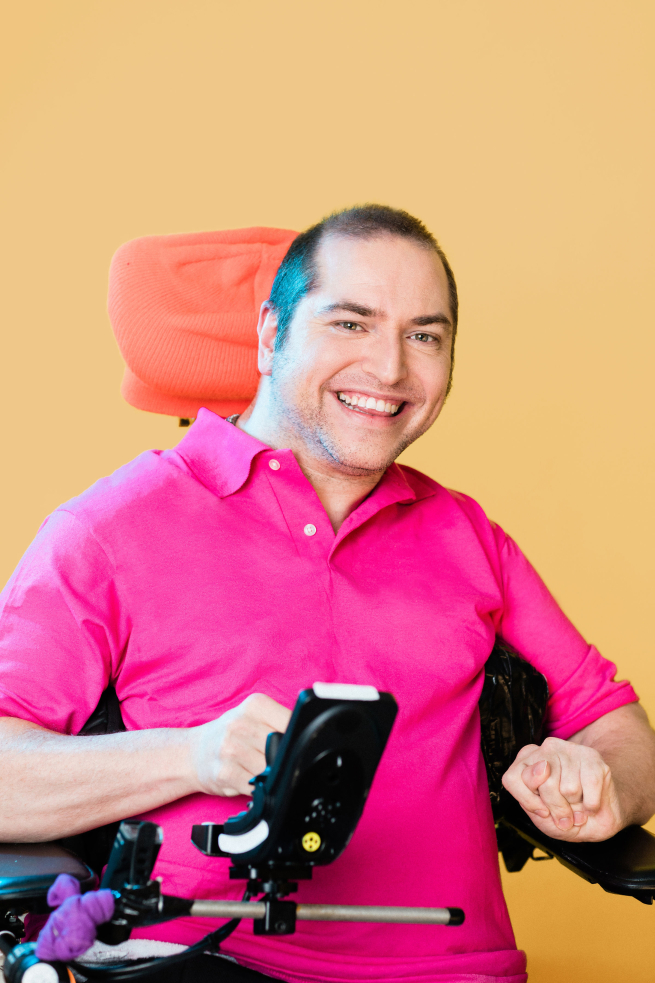
Andrew is a young white man sitting in a power chair. He has short brown hair and is smiling at the camera. He has a pink shirt which has two white buttons at the neck. There is a coral-coloured cushion behind his head. He is looks happy and is smiling

We asked Andrew questions about his writing process and what inspired him to write such an important book.

What made you decide to write a book and how was the process?

Funnily enough, I had wanted to write this exact book for years before being approached about it by Jessica Kingsley Publishers.  One of their editorial staff found me through my tweets, and said that they’d love to see an outline for a book, if I would take a meeting.  That was back in 2022.  I signed the contract and then took about 2 years, and several meetings to actually write the book.  I needed a lot of reassurance and encouragement because I didn’t believe that what I was saying had any value.  Once I got in the groove of writing, it was pretty seamless, but unearthing some of those stories and accessing that vulnerability was hard. 

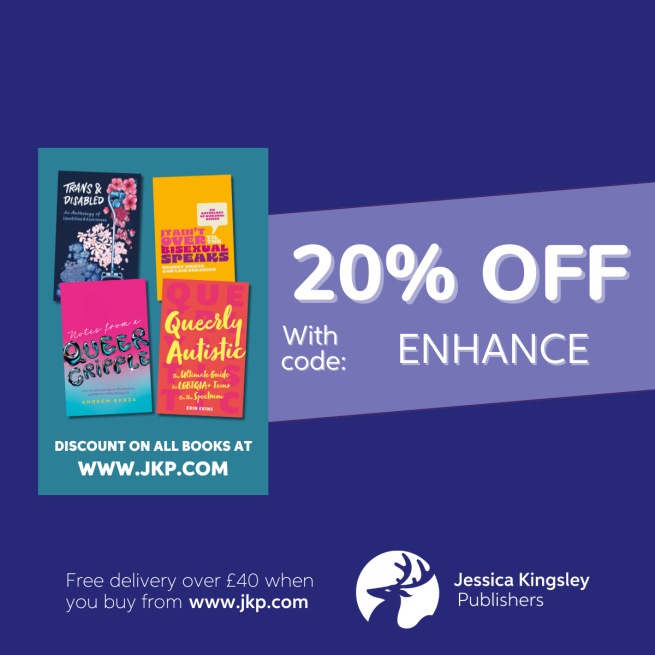
A blue box featuring four books by disabled authors. One of which is Andrew Gurza. It offers 20% off the books by using the code ENHANCE20 and free delivery over £40

Visit the Jessica Kingsley Publishers page to shop the book. Use code ENHANCE20 for 20% off.

How did you find being so open in the book about your sexual experiences and disability?

I have been talking about sex and disability and my experiences for almost 15 years, so I am pretty comfortable doing that.  I love talking about it because I think that it is just as important as talking about ramps, elevators and access, if not more.  While I was comfy doing it, there are some stories that even my family hasn’t heard, so knowing those stories would be out there has been nerve wracking, lol.  (Sorry, mom). 

Why are so many queer spaces so inaccessible for disabled people?

I was ready to write you a big, long, expansive answer but the truth is: ableism.  We have all this money in the queer community to donate to so many causes (and we should!) but for some reason (ableism) we can’t make a club actually accessible?  Come on.  Our attitudes around sex and disability need to change, and we need to address ableism in queer spaces first. 

How do you find being so visible online -do you find it a positive or negative experience? 

I’d be lying if I said it was easy to be disabled online as a public figure.  I am so grateful for all the visibility has brought me; a book, for one.  That said, I won’t lie, it has also been incredibly negative.  Some of the cruelest things I’ve heard have come from other disabled people.  So, I love the platforms that I have built, and I am always learning, growing and apologising when I misstep, but I am also learning to protect my peace.  I am so thankful when someone says they love my stuff, but I am also learning to be thankful when I am called out.  How can I do better?  That’s an important lesson that I am constantly asking myself. 

Your chapter on queerness and caregiving was powerful – what do you wish people knew about care and being queer/non-binary?

I wish that people understood that so many people with disabilities who intersect with queerness and disability who need care, may not be able to be 100% themselves by way of non-binary, gender non-conforming or trans identities, because they need care.  The care system is stuck in a binary place, and so many of us have to hide all of who we are, and that can be exhausting.  

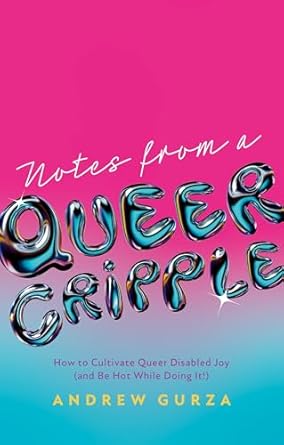
The blue and pink cover of Andrew's book: Notes From A Queer Cripple: How to Cultivate Queer Disabled Joy (and Be Hot While Doing It!)

What was one of the most powerful things you learned while writing the book?

I was constantly reminded that sex and disability are so taboo in 2025.  Every time I recounted one of the essays or sat down to write a new chapter, I realised that I had never seen anything like this in the world.  That realisation was both triumphantly exhilarating but also sad as f*ck.  I hope this book opens the floodgates for other queer cripples to tell their stories.

What advice would you give to other disabled queer people?

Talk about the hard stuff.  Don’t do what every other queer disabled cripple is doing.  Tell your story; I promise, we’ve heard nothing like it.  Fight for sexual rights and autonomy, they’re just as important as other forms of accessibility.  Be more disabled and f*ck the haters.

Visit the Jessica Kingsley Publishers page to shop the book. Use code ENHANCE20 for 20% off.

Want to read more blog posts? Why not visit our blog page

A lavender dial phone on a lavender wooden stool.

Simon Smalley on….life as a disabled gay man in the 1980s

By Disability, Sex & disability, Undressing Disability

We asked the author Simon Smalley to write about experiencing the gay scene as a disabled teenager in 1981. Simon is the author of ‘That boy of yours wants looking at,’ a memoir about growing up in Nottingham. He shares his experiences as LGBT+ History Month comes to an end, highlighting the importance of recognising stories like his all year around.

1981 was the International Year of Disabled Persons, and during the blazing summer, our sweating postman delivered a buff envelope. 

Inside it was a green certificate declaring that I was now officially registered disabled.*

This categorisation had been organised by a Job Centre employee who, with a self-congratulatory white grin, informed me that it would provide my liberation.

Frowning at his curious choice of words, I just had to ask.

“How?”

“As a registered disabled person, you can travel free on the city buses during off-peak times.”

Big deal. Okay, it would get me to the hospital for my grueling physiotherapy sessions five days each week, but it wouldn’t change how I hated my disability. My hatred was primarily due to the local doctor failing to recognise the dislocation of my right hip when I was fifteen. Instead, he’d attributed the cause of my painful, laborious limp to rheumatoid arthritis of the knee. My condition had deteriorated until the next year when an orthopaedic consultant made a correct diagnosis. Although I was immediately hospitalised for corrective surgery, irretrievable damage was already done.

The slip of green paper didn’t provide the liberation that I yearned for as an isolated, frustrated nineteen-year-old gay man. I wanted to meet others like me but faced many self-imposed restrictions about achieving this. I gradually retreated into my psychological shell, still scarred from the beatings administered to me by bullies at school because of my sexuality. Their ammunition was doubled when they added my disability as further justification for attacking me, and ultimately, this unbearable campaign resulted in my suicide attempt.

In my later teenage years, the glossy gay magazines I bought depicted handsome hunks grinning confidently, no doubt at ease with their gym-trim bodies. But none of the tanned Adonises had an atrophied leg four inches shorter than its counterpart, thus necessitating the wearing of an ugly, built-up orthopaedic boot to maintain balance. A copy of the American gay magazine, Blueboy, featured an article about being gay and disabled, but it held no answers for me. I didn’t hate being gay; I only hated that I had allowed my disability to dominate my life and prevent me from meeting other gay men.

My simmering resentment finally boiled over. I phoned Gay Switchboard and explained my predicament. The man on the phone informed me that there were informal twice-weekly social gatherings, which would be a gentle way to ease myself onto the scene. My determination was so overpowering that I went the next evening, yet upon my arrival, I baulked that I had to navigate two flights of steep, narrow stairs to attain my real liberation. Later that evening, I continued my journey by visiting a gay pub and club. Probably because of the secretive aspect of gay life that still prevailed in those days, the scene required venues that were unintentionally inaccessible to lower-body disabled patrons, thus precluding their participation. 

To exemplify this, the gay bar in The Hearty Goodfellow was in the cellar and was reached by a switch-back stairway. Whispers nightclub occupied the ground floor of an old factory, with stairs leading to the vibrant subterranean disco. What was to become my absolute favourite nightclub, Part Two, had a street-level disco and cruise area, but its bar was at the top of several wide steps, and the quieter lounge was up on the first floor. None of these venues contained disabled toilets and were not wheelchair friendly. 

Towards the end of the twentieth century, the accessibility to pubs and clubs for nightlife-loving disabled people improved, as did the attitudes of staff towards those customers, with new build venues factoring accessibility into the design.

Although there are improvements and positive awareness of the disabled population, old stigmas remain. I once challenged a man who felt it acceptable to point at me and loudly complain to his friends about disabled people being allowed into a gay club. I told him that although my disability was evident, there are disabilities that are not immediately noticeable, such as his.

His outrage was instant. “I haven’t got a disability.”

My retaliation was calm. “Yes, you have. Your ignorance and prejudice are your disability.”

As his friends laughed at him, I knew that I’d attained a kind of liberation not intended by my receiving the slip of green paper.

*Please note: This green card and registration are from the disabled person’s Employment Act of 1944. The Government set up a Disabled Persons Employment Register. It was known as the ‘green card scheme’ because certificates were given to disabled people on green cards. This got repealed when the disability discrimination act 1995 and subsequently the Equality Act 2010 came into place.

You can read more of Simon’s work by visiting his website. 

Want to read more of our blogs? Visit our blog page to get access to our articles.

A cartoon of a mobile phone with a question mark

Alix Zander on…..finding your gender, self and identity before the internet

By Disability, Sex & disability, Undressing Disability

How does a queer, non-binary person, who was born before the internet, come to understand themselves?

“Boys will be boys”, but “girls should know better.”

From the moment I became aware that not all kids were the same, I knew I was ‘wrong’. The way that ‘girls’ were expected to behave, the toys they were allowed to play with, the clothes they had to wear, the way grown-ups spoke to them… all very different to the world that ‘boys’ were allowed to inhabit. I didn’t feel like a girl.

It seemed, to me, that boys were allowed to behave mischievously, get grubby, be cheeky, run wild, have adventures, not consider any consequences to their actions. Girls, on the other hand, should play tea parties, dress up dolls, be princesses.

Pass me a bucket! That was not me.

Sealed the deal

For some reason, age 4, we were once sent to the toilet at play time in pairs. I was with a boy. Oh… My…life.  What was that?! He could pee standing up. He didn’t have to go through all the shenanigans of accessing the toilet via various processes of undressing. Just a quick get it out, pee, put it back, done. I was sold and I wanted one of them. And if that’s what being a boy was, then, I wanted in.

Wrong

But nobody believed me! Clearly I wasn’t a boy! I didn’t have the desired body part, and everyone (except me) insisted I was a girl. As we got older, more differences appeared (although I would say now that many are socially constructed and didn’t necessarily ‘prove’ anything) and I realised that I didn’t actually ‘feel’ like a boy either.

Alien

Cue the next 3 decades of my life feeling like a total freak. I felt I must just be inherently wrong.

Everybody else was either male or female, and seemed to be accepting of that. I was convinced I must be some genetic mutation, some weird alien, the only one of my species in existence. But I couldn’t tell anyone.

I already hated being the focus of any attention and every time I had tried to talk about gender I had been shut down. There are boys and there are girls, and boys fall in love with girls, and that’s the way it is. (But don’t get me started on heteronormativity)

No representation

Kids’ TV was a couple of hours a day, on a choice of two channels. Everything else was grown up telly – serious and boring. The internet wasn’t a thing, and there was no point trying to find something in the library – I ‘knew’ I was the only one; so nothing would have been written about it. Everyone on TV was cishet (without the terminology), which reinforced my deeply negative sense of self.

When I was 15 I caught a documentary about a transgender guy. I was blown away to discover that there were people born into the wrong body, and that correction was possible. Except that wouldn’t work for me. I’m not male or female. Again – just me then.

Internet

When the internet arrived, just like with the library, there was no point exploring my ‘condition’. Everything I had ever encountered reinforced that I was just wrong.

Until, completely by accident, aged 32, I discovered the writer Meg-John Barker. They looked like me, dressed like me, sounded like me, and they’re not male or female. M-J is non-binary and there it was… the term for it. It wasn’t just me.

Others

And it turns out, there are others. Who knew!

Artist and film maker, Fox Fisher and their partner Owl (both non-binary) have worked tirelessly to educate and raise awareness around gender and non-binary identities for almost a decade. Christie Elan-Cane has been campaigning for recognition of genderless British citizens for over 30 years. Elan-Cane took the UK Government to the Supreme Court in 2021 for the right to be issued with gender marker X passports.

The case was dismissed and the matter has since been lodged with the European Court of Human Rights, where it has sat since June 2022 awaiting even a first decision.

Pride

The intervening years (almost 20), since discovering it’s not just me, have been a roller coaster of depression, shame, disability, self-exploration and ultimately growth.

Finally I am able to live my authentic life in which I can navigate the world being proud of the unique individual I was always meant to be.

Want to write a blog for us? Visit our page on how to get involved to find out how

Want to read more blogs on disability? Visit our blog page for a list of articles

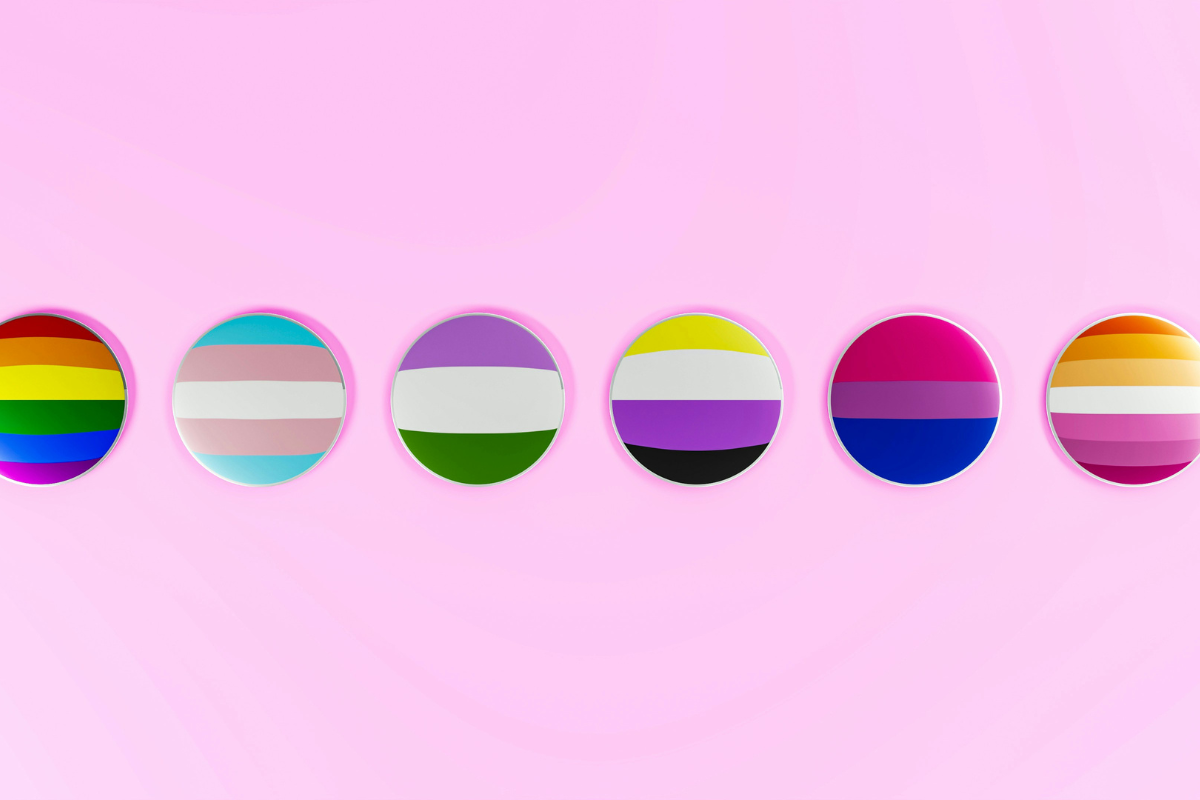
A row of LGBT+ flags as pins. There is a rainbow, trans flag, a sexual flag, non binary, bisexual and lesbian badge in a row

Love Lounge: Join us on the big Queer bus tour

By Event

Jump on board with us & celebrate LGBTQ+ History Month!

Coming to a college near you! On the 17th & 18th of February, between 9 am-6 pm, jump aboard with the University of the Arts London and our Love Lounge on our ‘Big Queer Bus Tour’ across London and celebrate this LGBTQ+ history month, as we look at love and liberation and why we should be honouring this month in the current climate we live in.

This open-top bus tour will journey across many UAL colleges and halls of residence allowing students and staff to interact with our many creative activities and exhibitions on board.

Things to look forward too:

  • The Love Lounge ❤️‍🔥 – Do you have a dating dilemma? A sex question you don’t want to ask your friends about? Or need support with a recent break up? Our ‘sexperts’ at Enhance the UK are here to answer any questions.
  • A Sapphic Boob Corn hole game 👀
  • Manifestation Wish Tree 🌲 – Show your support or simply express your anger at recent events affecting the LGBTQ+ community.
  • Free contraception and information on LGBTQ+ sexual health.
  • LGBTQ+ Activist Couple exhibition –  a look back through the decades of the trailblazers who got us where we are today.
  • LGBTQ+ community organisations with giveaways 🥳
  • Free queer beer, mocktails and refreshments from some surprise companies. 🍻🍿
  • And much more! 🤩

Students and staff are welcomed to hop on and hop off the bus throughout the duration or simply come and visit us when you see us at sites. It’s up to you! 😌

Sites to spot us at:

Colleges: LCC, CSM, Wimbledon & Chelsea College of Arts.

Halls: Archwood House , Gardens and Portland House , Highline Building, Furzedown Student Village.

Disclaimer if you can’t see your site or hall here this will be down to parking restrictions for a vehicle of this size, we did try! We will be hosting pop up stall at the college sites and halls where we cannot get the bus to on different dates. 🏳️‍🌈🙌

Find up-to-date information and route plan by visiting the UAL bus tour page!

Censorship and social media: there are lots of cartoon social media buttons like a like, a heart, thumbs up on a peach background

Censorship and Social media: Can we talk?

By Sex & disability, The Love Lounge questions, Undressing Disability

We need to talk about social media. 

It doesn’t feel good out there and if we are honest, it hasn’t for a while. Undressing Disability is a sex-positive, informative, educational resource. We are a campaign run by, designed by, written by disabled and neurodivergent people, for the very community we are a part of. 

It started as a way to showcase how sexy our community is and that disabled people still want and enjoy sex. . It now includes a podcast, educational resources, a free support service called the Love Lounge, events and training. As part of this, we often share photos of sexy disabled people being their gorgeous selves. 

Hell, we’ve even organised the photoshoots!

Noticing the difference

However, it’s getting harder and harder to reach our audience. Earlier this year, we decided to come off Twitter/X after it became apparent our community was leaving – with good reason. While it was hard to say goodbye to the hard work we had put into it, it was the right decision.

Instagram has been the main social media page for us for some time. We have made so many beautiful friendships and collaborations through it. However, Instagram does not enjoy our content nor does it like many of the other sexual health educators, influencers, and workers who are all part of it. We do not use TikTok but do note that we’ve heard similar complaints about the content there. 

Visit our Undressing Disability Instagram page.

We’ve watched as our posts on consent or safer sex are barely viewed compared to ones that aren’t about anything sexual. We’ve tried hiding our words by writing seggs instead of sex. We’ve added the symbols or numbers in desperation, like k!nk instead of kink or even bre@sts instead of breasts. It’s time-consuming, problematic and infuriating. Not to mention, ableist when you consider how many people using screen readers might struggle, or people with dyslexia. It also looks ridiculous. 

It’s important to know the right words for our bodies, our sexual health and our sexuality. By removing such words, we are contributing to health illiteracy. Avoiding these words feeds into the idea that such language is dirty or bad. 

It’s what we have to do to avoid our account not being seen at all, banned, blocked or removed completely. There are so many ways in which this censorship affects disabled/neurodivergent people. We aim to make our social media content as accessible as possible by using things like alt text, checking the colour contrast and video captions. It’s frustrating to have to write @n@l because we can’t use the real word, making the text less accessible. Even putting these words into the actual graphic appears to no longer work. We do offer an alternative, that if people are struggling to read these words, they can get in touch with us and we will type it in a message – but this is a lengthy alternative that frankly, no one should have to do.

This censorship feels as if it ranges from the real (the wording, the blocking and banning) to the ridiculous (apparently we can no longer use the aubergine emoji as it’s flagged as sexy content) to the harmful (the loose wording around sexual roles could place LGBT+ people at a greater risk of censorship). 

How does this harm us?

Hands up if you feel your sex education at school was less than informative? Does the sex information in magazines feature disabled models or voices? How many books are written about sex positions or advice for disabled people vs non-disabled people?

Younger generations are turning to social media to get the education they feel they didn’t get at school. This includes disabled people who are often left out of the conversation entirely. If the chance to access safe, accurate information is removed then where does that leave us? 

Not to mention, creating content is time-consuming, expensive and exhausting. A lot of disabled people do not have the energy or resources to keep replacing content that is taken down nor should they have to.

We travel around the UK with the Love Lounge offering free advice to disabled people. We know that disabled people have a lot of questions about sex, relationships and love. We also know that they often feel lonely and depressed without a community. This is the positive side of social media, it can help people to access information and connect with people. 

Visit our Love Lounge page to find out how to get free, confidential support

So what is the answer?

The immediate response is usually to leave social media. This isn’t possible as to do so leaves charities like ours out of the conversation completely. It means we would struggle to speak to our audience at all. 

The ‘answer’ or the solution is for the social media companies to resolve. This means investing in humans instead of bots when it comes to content moderation and clearer guidelines around their wording. For those of us in the sexual information or education field, is it that they have a special verification mark so that readers know the content is fact-checked and researched?

It might even be that we leave the platform to its own devices and join one made by the community, for the community.

We might even get to use the aubergine emoji again.

Want to join our mailing list to hear all about the events, updates and community news? Visit our mailing page and add your email.

ADHD: A person sitting on a computer on a bed. They are relaxed and wearing a white t-shirt with long dark hair

Love Lounge: I have ADHD and I’m struggling to find a relationship

By Sex & disability, The Love Lounge questions, Undressing Disability

The question:

Hey,

I’m struggling with being newly diagnosed with ADHD in my mid 30’s. I’m very confident, sociable and achieve well at work too.  The area I struggle with is in relationships. I have had people cheat on me, I get bored easily so seek people who are as crazy and fun-loving as me and find dating apps just the worst! The chat is so boring and every time I don’t like someone, I think it must be my fault – why can’t I accept having a normal middle-of-the-road kind of relationship?

The other thing that is worrying me is medication for my ADHD. I like who I am; I like my carefree nature and have real sadness about losing that. Who am I underneath, after the medication suppresses the ADHD? I’m also in therapy at the moment to help adjust to my new diagnosis.

Thanks for your time,

Amy

The answer:

Hello Amy,

Not everybody wants the norm…and in today’s world, we’re able to be freer in our choices of how we date, co-habit, and make a family.  Particularly with more people being diagnosed or identifying as neurodivergent in their 30’s and 40’s this can help explain why they maybe haven’t felt like they’ve wanted or enjoyed the ‘mainstream’ kind of relationship.

Surely, we can’t all be cut out to fulfil society’s doctrine of monogamy and 2.4 children. So cut yourself some slack, you’re not strange or awkward to not find this vision appealing, or doable, for you. Own it and be confident about the type of person and relationship you’re wanting – and then hopefully you’ll attract like minded people. 

With regard to losing your carefree nature – I can understand that fear of loss. I think any kind of therapy, understanding oneself, healing etc can all feel scary because we only know what we know. Who will we be on the other side? That’s a legitimate concern. However, the medication (and therapy) will help you identify behaviours that don’t work for you now, or that create more chaos, and you can find suitable strategies to manage these. If the medication helps take the edge off, it doesn’t mean it will take away your personality – you’ll probably find it just helps you cope, organise, think more easily.

Hopefully alleviating stresses in your life.  It won’t eradicate ‘Amy’.  As you adapt, picking and choosing the traits that you’d like to keep that work for you, and letting go of those that don’t serve you well, people may think you’re behaving differently and therefore be slightly different with you too. That’s normal, you’re no longer playing the role in a game they’re used to you playing. Overtime, you will reassert your boundaries and they will respect this.

It’s a process, but you will only ever be a more enhanced version of you. Remember it is all within your control too – whether you stop meds, do more or less therapy, choose to let people know you’re on a new pathway etc.

Good luck!!

Zoe  

Want to read more about disability, love, sex and everything in between? Of course, you do! Why not visit our page with more Love Lounge questions


Top