Tag

disabled relationships

Dee Smith on…..disability advocate work

By Sex & disability, Undressing Disability

Dee Smith on…..disability advocate work

At just 27 years old, disabled model and writer Dee Smith has modelled for London Fashion Week, featured in Cosmopolitan magazine, and launched her own podcast.

We spoke to her about how she’s combining creativity and disability advocacy to champion self-expression and inclusivity for disabled people.

Tell us more about your disability advocacy work. What is it all about and what made you want to start advocating in the first place?

I’m creative. All my advocacy work revolves around things I love and am passionate about, such as creating a photoshoot to model or writing a poetry piece. I went from able bodied to disabled and all of a sudden I noticed how ableist and inaccessible the world is because of toxic stereotypes that are NOT true. So I intended to change that through creative avenues.

You’ve modelled at London Fashion week and share images from many amazing photoshoots via your Instagram. What do you love most about modelling?


The freedom to be creative! I get to be anyone and do anything. I can be artistic, scary, beautiful, sexy, honest. The possibilities are endless! Plus, it inspires others and shows people what I and other disabled people can do. It educates.

How has your relationship with sex and desirability changed since becoming disabled?

It was a journey. I went from thinking I was undesirable and unwanted because of my disability and what society has told us. I had to learn to love my own body and embrace my sexuality again. Learning to love all of me, disability and all, has been a journey.

What is one myth or stereotype about disabled people that you would like to dispel?
That we aren’t sexy, beautiful, and desirable with needs.

What are your goals for the future? Do you have any dreams you hope to realise or upcoming projects you’d like people to know about?

My goals are to advocate more in bigger, more mainstream media where disabled advocacy can be heard and taught. Hopefully branching out into acting. I also have a podcast on Spotify called Training Wheels where I talk to all kinds of people, from all walks of life, and ask them to share their stories.

You can find out more about Dee and support her work via her Instagram @dee_smithxoxo and her podcast “Training Wheels” is available to listen on Spotify.

Sam Ranke on…the importance of finding your tribe

By Disability, Sex & disability, Undressing Disability

Most well rounded, emotionally available people would like to think they are somehow impermeable to bias. That being a good human arms you with a cloak against the unconscious bias that seeps in all around us. 

Unfortunately, the “good person, bad person” binary doesn’t exist when we look at prejudice and discriminatory ideologies and actions. Truth is we are all born into a world where harmful stereotypes and tropes are systemic, institutional, and darn insidious in their nature. We all inhale the unconscious bias smog that seeps in around us, through our media and social structures 

This also includes me. 

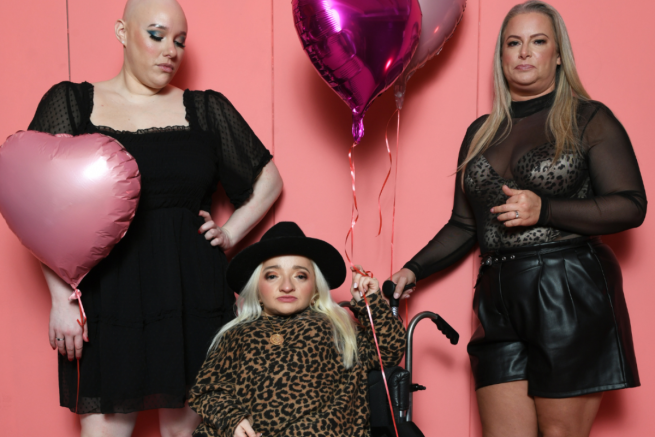
Three people are in a group: one person is wearing a black dress and holding a pink heart balloon, another is sitting in a wheelchair wearing a leopard print top and black hat. The other person is standing wearing all black

Oh yes, for years my ableism was real and stank! 

What’s more important however is how I got to where I am today. As a proud Disabled woman. 

At the ripe old age of thirty-eight, I’d describe myself as a cat mum, Buffy The Vampire Slayer über fan, home interior enthusiast. An actor, broadcaster, podcast host and consultant yet, my most treasured accolade to date is being able to say, without hesitation, that I am a proud Disabled woman. 

This, however, did not happen overnight. Coming to this conclusion and feeling it deep within my soul, in every ounce of my being, took years and still sometimes feels like an uphill battle just to maintain. 

For the past twelve years I’ve devoted almost all of my career and free time supporting and learning more about Disability culture and the Disabled community. Trying my best to amplify the voices of my fellow community whilst learning to love my own difference and feel pride in a part of my life that holds such presence in my day-to-day life. 

I was born with a condition often referred to as Brittle Bones, essentially my body does not produce type one cologne. This means my bones and organs are weak. I’ve had hundreds of fractures throughout my life and as a baby would be carried like a prized chihuahua on a cushion, too fragile to be cradled typically how babies would (this fact often makes me chuckle, as I question where my Diva behaviour comes from – (Clearly, we have the answer.)

I was the only person in my family with this condition and it came as a surprise to them all.  

Two years ago, I published my memoir You Are The Best Thing Since Sliced Bread and during this process I had the pleasure of interviewing my mum. Heartbreakingly she describes my birth more like a bereavement rather than a day of joy and celebration. Not only did no one come to the hospital to beam congratulations or go for a few drinks to wet the baby’s head. No, they all saw my birth as a tragedy. Even the doctors who delivered me braced my young parents for the worst: “I’m so sorry there is something wrong with your baby” an all too familiar sentence. 

You see, not only had I come into this world with a diagnosis – brittle bone disease – but I came into this world with a label. That label was Disabled. 

Synonymous with shouldn’t, couldn’t and wouldn’t.

I’ve spent all my life negating those labels. Yet, even as tenacious and feisty as I am, I too fed into the belief that Disabled meant lesser than. Less cool, less accomplished, and worst of all less deserving. 

I grew up with the same teenage angst and body image issues as most kids but on the whole, I liked who I was for the most part. I was sociable and had many friends. Sure, as I grew the more, I noticed how my Disability was an issue for others, but I still had a good grounding in self-love. I liked me, but I really didn’t like other Disabled people. 

In fact, growing up I didn’t ever mix with any other Disabled kids outside the parameters of going to my annual check-up at my specialist hospitals. 

Then and only then did I meet other people in wheelchairs or with the same condition as me, brittle bones. When I looked at them, all I saw were the stereotypes or at least that’s what I convinced myself I saw. 

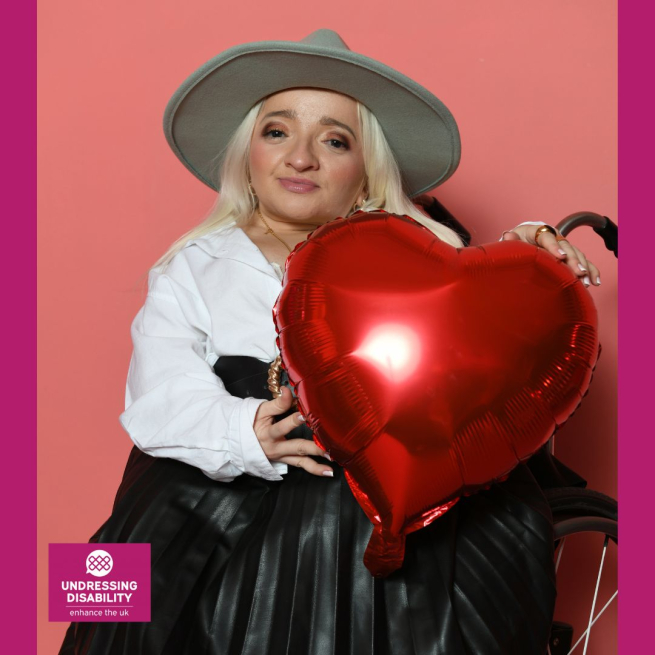
Sam has long blonde hair and is wearing a light green hate. She is sitting in a wheelchair holding a red shiny balloon shaped like a heart. She wears a white shirt and black skirt

Truth is, I was so scared to identify with any part of my Disability identity that I didn’t allow myself to even befriend or acknowledge others from my community. 

This may come as a shock to some of you reading this as horrible as my ableism was, I wouldn’t say I am ashamed to admit that this is how I spent most of my childhood and young adulthood, rejecting disability culture and other Deaf and Disabled people. 

Can you blame me? 

I had no one telling me it was okay to be Disabled, more than ok, it was beautiful, and I should be unapologetic about it. 

I had no one tell me I was allowed to feel pride and love for a part of me that had shaped who I am today. No one had told me that I could be loved as a Disabled woman or feel like I could be admired and cherished. 

I had convinced myself that the only way I could and would be accepted by society was if I shunned anything that encapsulated any part of my Disability identity. 

This, however, was a very lonely path. 

Not only because I needed to be told that I am worthy of everything life has to offer and more but also because other Disabled people are bloody amazing and I absolutely needed some of that energy in my life. 

I’d lived in a world that pushed the divide and conquer narrative because alone we are easy to manipulate. Alone, we are not strong, alone we are vulnerable. 

What I really needed was my tribe. Because once I found them my life changed forever. 

This is where I do a shameless plug for my memoir You Are The Best Thing Since Sliced Bread available in hardback and audio, to find out exactly what happened when I embraced my Disability identity, my tribe and my community. 

You can purchase You Are The Best Thing Since Sliced Bread by visiting this link to the Amazon website.
Family Reaction To My Relationship with a Disabled Guy

By Disability, The Love Lounge questions

The Question

Dear Love Lounge,

I need your advice on my family’s reaction to my relationship with a disabled guy. My parents have met my partner numerous times over the past year, and we all get along well. Last month we moved in together and plan to get married. My Dad has suddenly gone a bit weird about it all, asking questions like “Who will put up shelves for you, and who will cut the grass? I’ve pointed out that its not 1950 and that I can put up shelves and cut the grass but he’s still going on about it.

My partner knows there’s something upsetting me but I haven’t told him about my Dad’s comments yet. I’m not quite sure how to handle that conversation as he loves my folks. It’s really upsetting that my Dad is being off when it should be a happy time for us. Help please!

Ellen x

Our Answer

Hi Ellen,

Thanks for opening up about this scenario. I think it is more common than you may think, although that doesn’t make it feel any easier for you!
Being in a relationship with a disabled partner can indeed bring practical problems. But there are invariably solutions to most of them. Your parents naturally want their daughter to be looked after well but your Dad is focussing on what your partner can’t do!

The generations before us had their jobs clearly divided into ‘blue and pink’ jobs. Many of us now subscribe to that notion less and less. Perhaps your Dad’s perception is that to be the ‘man of the house’ you have to put up shelves and mow the lawn. This is how he felt he supported the family and looked after his girls. Doing these blue jobs validated him as a husband and father.

I wonder if it might be worth a chat with him about this way of thinking – as this isn’t necessarily dependent on your partners disability. You could have a non-disabled partner who is useless at putting up shelves!

I would also consider mentioning this to your Dad – what would happen if you married a non-disabled person and then they became a wheelchair user? You would naturally have to adapt to a new way of life as he may no longer be able to do these tasks. I doubt your Dad would encourage you to leave them because they can no longer mow a lawn.

It sounds like your Dad is a little fearful of the future and has gone into fatherly protective mode.
A simple, adult to adult chat to reassure him may be all he needs.

I think not getting angry or defensive will help you. It appears this is really coming from a place of concern from your Dad rather than a place of mean prejudice. A gentle talk, with confidence and assertion from yourself about how you will manage the household and the relationship as a whole, will allay his fears. It’s encouraging that he gets on well with your partner and has known him for a year. Your Dad will have seen the lovely attributes of your boyfriend; those you’ve fallen in love with. Hence why being in a relationship with a disabled partner doesn’t bother you, as it is about much more than practicalities of a disability.

It’s great that your partner really likes your parents, and I can understand why you may not want to disclose your Dad’s comments.  It could hurt your partner and emasculate him perhaps.  Or conversely, he may totally empathise with your Dad and be willing to talk to him to reassure him.  He may express how he contributes to the partnership and what that looks like to him.  His dedication, emotional support, commitment, love – all more important than him making Wimbledon-quality lawns!

And hey, if it’s such an issue, or your partner fancies mowing – he could always get hoisted up on to a ride-on one 😉

Good luck with the chats.  I have every confidence this can be easily sorted with a bit of empathy and compassion from both sides!

Zoe x

Stay Connected

Got a question for our Love Lounge team? Please contact us and we’ll do our best to help. Follow us on twitter and Instagram to keep up to date with all our goings on. Join our Undressing Disability Hub to learn more about sex and disability and to access free resources. #UndressingDisability #LoveLoungeUK


Next question

How safe is sexting?

By Sex & disability, The Love Lounge questions

The Question

Hi Love Lounge. How safe is sexting? My boyfriend and I got together 3 months ago and enjoy an active sex life. We met at the gym and got talking as we both have lost a limb, him to cancer, me to a car accident.

Funny how people come into your life at the right moment. I had recently split up with my ex and was feeling a bit down about myself and he is the pick me up I needed. We are both on the same page when it comes to sex and had been getting it on a lot prior to lockdown.
Now both living separately we’ve started having phone sex, using the video apps to get down and dirty. My boyfriend asked me to send him some saucy photos to keep and look at whenever he likes.  I’m feeling hesitant to do that. He doesn’t understand why and it’s caused an argument. I am wary of photos of me in the buff being stored somewhere and now he’s quizzing me on trust and making me feel bad. But I worry. How safe is sexting? I feel it’s a bit early in our relationship for him to have these pics. The video sex is different as we are both together in the moment and afterwards its gone.
Is it safe to send images to other people? Am I being a prude?

Our Answer

Communication

Firstly, it’s brilliant that you’ve been honest about how you feel about sexting. The fact that it’s caused a row is not necessarily a bad thing, especially at the beginning of a relationship. Setting boundaries and communicating about why these exist, and what they mean to you is important. It’s how we learn to respect one another, appreciate each other’s values and show consideration.

So how safe is sexting?

Good question! Sexting is very popular amongst consenting adults. For me, it comes back to one main factor: personal identification.

Even if you don’t post photos that show your face, your body may be identified by:

  • tattoos or birth marks
  • where you live – (posing in front of your fantastic wallpaper)
  • the data stored within an image

Reducing Risk

I’d recommend you read this article on 7 Crucial Tips to Safe Sexting . It provides information on how to remove the data from any images you choose to send. Remember that screenshots can still be taken from video calls too, so be careful there – especially if your face is in shot.

This article provides advice on How To Sext Safely.  It suggests which sites may be safer and the risks of using an app like Instagram which links to your identity.

Trust

Of course you should wholeheartedly trust anyone you send a nude to, that goes without saying. Try having an open discussion about your worries. Raise the points around the safety of sexting and what your boyfriend might do with the images (no need to argue!). Set some boundaries that you are comfortable with.

Don’t feel pressured

If he doesn’t understand or try to calm your worries by reassuring you, maybe he isn’t the guy you should be sending sexy photos to. Don’t feel under pressure to do anything you don’t want to do. Someone who respects you won’t put you in that position.

Hope this helps, and sending all best wishes,

Emily x

Have you got a question about sex and disability or intimate relationships? Write to us and our sexperts will help. Keep up to date with all our Love Lounge questions by following us on social media. On twitter we’re @ETUKUndressing and on Instagram @UndressingDisability.  #UndressingDisability

Boring, Routine Sex

By Sex & disability, The Love Lounge questions

The Question

Dear Love Lounge,
I am a visually impaired woman in her 40’s and my question is about boring, routine sex. My husband of 15 years has always been a very sensual and a loving lover but lately any bedroom action has become routine like. I can’t even spice it up by fantasising in my head.  And talking to my fella about it only makes it worse. He gets really moody and implies I’m criticising him when I suggest we shake things up.

My friends and I discuss our sex lives and I don’t know if it’s an age thing, or a long term relationship thing but I know I’m not alone in needing more in the bedroom than I’m currently getting. Any tips for approaching this topic in a way that won’t bruise my husband’s ego would be ace, thanks.

Our Answer

Hello.  Boring, routine sex, as you put it, is not unusual for many couples. Especially if you’ve been together a while or have had a change in the circumstances of your relationship recently.

Communication is key

Communication of some kind is the only real answer here. Maybe you could change your approach to discussing this with your husband who is feeling defensive?

Instead of talking about boring, routine sex perhaps take it back to basics and ask him about what he likes in bed?

When we’ve been with someone for a while, it’s easy to think we know everything about them, including their fantasies and desires . As with anything in life, our tastes can change, and he might have felt unable to express this change to you. A more open, honest and positive chat might just do the trick.

What do you want out of your sex life?

If talking it through doesn’t go to plan then it’s time for Plan B. Ask yourself. What do I want from our sex life? Figure that out then make a move with something new such as:

Taking the initiative and spicing things up in a way that makes you feel sexy and in control might be the wake up call your husband needs to respond in the way you want and be more inventive in general.

Give it a go, hope this helps!

Emily x

Got a question about relationships, disabled dating or sex and intimacy? Write to us and our sexperts will offer free advice.

Keep up to date with all our Love Lounge questions by following us on social media. On twitter we’re @ETUKUndressing and on Instagram @UndressingDisability.  #UndressingDisability

Love Lounge Top Tips – Sex that’s out of sync

By Disability, Sex & disability, The Love Lounge questions

Positioning, pain and having those oh-so-intimate conversations in the bedroom – topics that we regularly get asked questions on at the Love Lounge. Seductive Hollywood movies and porn films are full of sleek, perfectly angled bodies having sleek, perfectly angled sex. But what happens when what really goes on between the sheets isn’t quite as in sync as we’d planned?

Read More
Top